Work / SANA e-Escape: The Last Hour
SANA e-Escape · Youth drug-prevention game · Season One, July 2026The Singapore Anti-Narcotics Association commissioned an e-Escape game for youths aged 13 to 20, where the player pieces together what happened to a friend, Kai, from the fragments he left behind. The concept had already won the pitch; from kick-off I led it end to end as Lead Designer and Game Master, from the story to the shipped screens.
At a glance
The project
I did not pitch this concept, our Innovation Lead did, and it won us the project. But a pitch is a promise on a few slides. Making that promise real, a game with a story, logic and screens that hold up the moment someone plays, is a different discipline, and it is the one I own.
That means resolving everything a slide can gloss over:
Co-creation
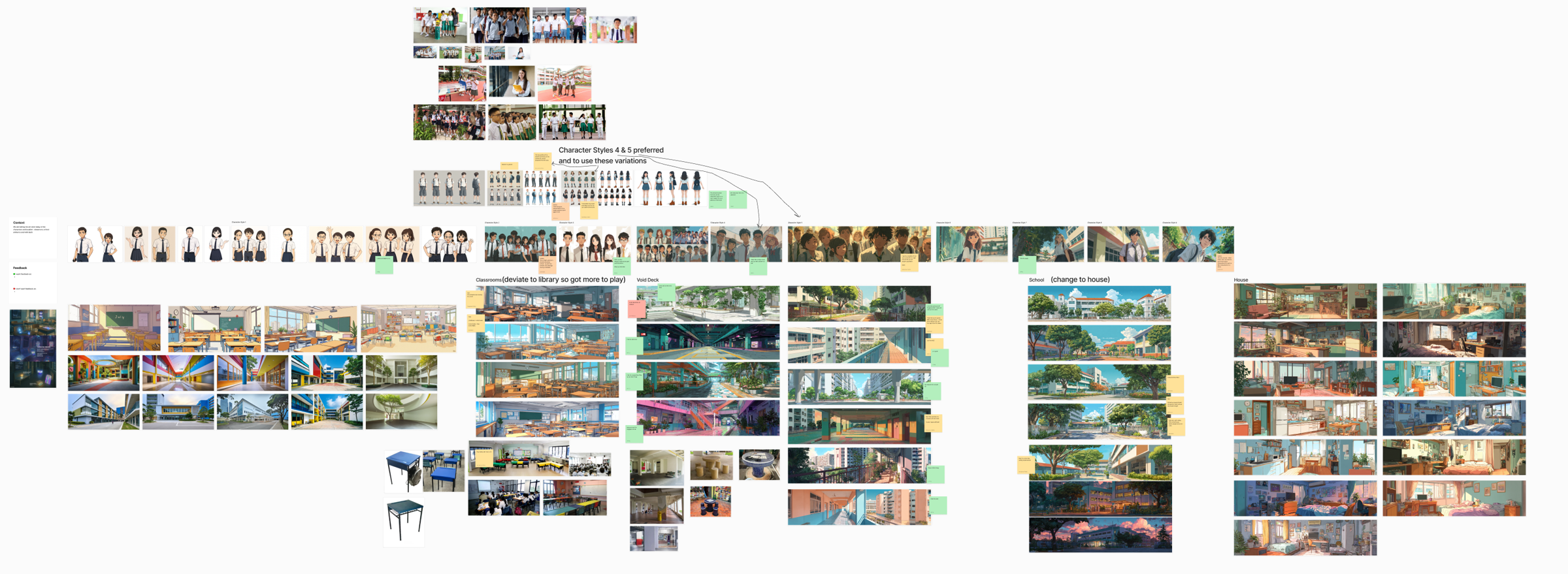
I wanted SANA to help shape the experience rather than only approve it. Using LUMA human-centred design methods, I planned and facilitated three rounds of co-creation workshops with SANA and our internal team. We started by defining what a good e-Escape experience should feel like, then worked through the three main scenes together, mapping the zones players could explore, what objects might contain clues, which moments could become puzzles, and what the player should learn before moving on.
The workshops gave us the ingredients. My job afterwards was to turn them into a game: I synthesised the ideas and mapped how the player would progress across all three scenes, how clues connected, when information about Kai should be revealed, and how each interaction fed the larger mystery.
It created a useful division of ownership. SANA brought subject knowledge. The wider team brought ideas and production perspectives. I facilitated the process, made sense of the outputs, and translated them into the final game system. By the time we moved into detailed design, the client was already invested in the world, because they had helped create it.
The context
Kai is the friend at the centre of the game, the person the player spends the whole story trying to understand. For that to work, he had to feel like a real teenager, not a vehicle for anti-drug messaging. An early direction made him a high-achieving student cracking under academic pressure. We moved away from it: it drew too narrow an idea of who becomes vulnerable, and turned Kai into a familiar cautionary character.
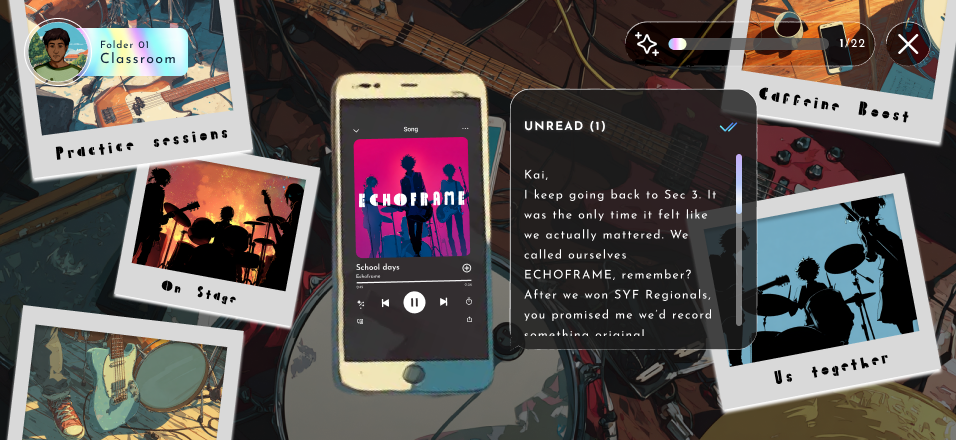
So I made him a singer, the vocalist and guitarist of a three-piece band, ECHOFRAME. Music gave him friendships, memories, ambitions and something to lose, and it gave us a richer world to hide the story in. Lyrics could become clues, posters could carry memories, photos could reveal relationships, objects from rehearsals could become evidence. I wanted someone who had a life before the problem, not a character built around it.
Making it feel current
One of my early references was 13 Reasons Why. Its central device is simple: recordings arrive after a death, and each one reveals another piece of what happened. I was interested in that structure, not in recreating the story.
For THE LAST HOUR, the tapes became Kai's old digital camera. The player arrives home to find a package waiting at the door. Inside is Kai's camera and a handwritten note: "For you. Don't show anyone." Switch it on, and three folders appear, 01_CLASSROOM, 02_VOIDDECK, 03_HOME, with only the first unlocked. Each folder takes the player further into Kai's story, and what first looks like a collection of objects, messages and memories gradually becomes evidence of things the player had missed.
This connected naturally with what we heard when we asked younger colleagues, around 18 to 19, a simple question: if you were dealing with something deeply personal, where would those thoughts actually show up? Compact digital cameras were returning as personal objects, and private messages, photos, notes and music were far more believable places for Kai's thoughts to live than a diary ever would be.
So the camera solved two problems at once: a contemporary object that felt plausible for the character, and a narrative device capable of carrying an entire escape room. More importantly, it set the original meaning behind the title. The player was not simply solving a mystery about Kai. They were reconstructing the final hour in which they might still have changed what happened.
The scope change
The original story focused on vaping. We had already established the mechanics and laid out the interactions when SANA asked us to broaden the content to drugs more generally. From their side it made sense: they could not build a prevention experience that suggested vaping was the only substance to understand.
From a game-design side, it touched almost everything. More substances meant more information, and more information meant more chances for the experience to become instructional. An escape room stops being an escape room very quickly when every interaction becomes a fact card. We had to absorb the wider education scope without losing the mystery, pacing and character story that made the game worth playing. That became one of the central constraints throughout.
Building the game
The workshops gave us environments and ideas, not a working system. As the main Game Master, I mapped the whole experience, from onboarding and character selection through interactions, puzzles, hints, collectibles, scoring and the branching ending. Every interaction needed a purpose: some revealed Kai's story, some unlocked clues, some fed a puzzle or shaped the ending, others simply made the world believable enough to explore.
The hard part was keeping those systems connected while still giving players freedom: a clue could not appear before the player could understand it, a puzzle could not depend on something they might never find, and reveals had to arrive in sequence without feeling linear. The final logic map became the project's source of truth, for the developer, the designers, the illustrator and the client, and for me it was how I kept the game from breaking every time one piece changed.
I designed the puzzles as part of the narrative, not separate mini-games. A code should come from something the player noticed in Kai's world; a clue should reveal something about him before it becomes useful; a collectible should feel like evidence, not a reward pasted on top. That tied every puzzle to narrative timing, so the player felt like they were reconstructing what happened to a friend, not clearing a checklist.
A drug-prevention experience can easily look like an educational microsite with puzzles bolted on. To avoid that, I studied mobile games such as Reverse: 1999 for how their interfaces build immersion, and borrowed their angled, slanted UI over conventional rectangles. Menus, dialogue and controls were made to feel like a mobile game, sitting over the illustrated environments rather than dominating them, across onboarding, exploration, puzzles, collectibles and endings.
This was also one of the last projects where I went deep into UI craft myself. After spending more of my recent work leading teams, research and strategy, I wanted to return to the screens and design them by hand.
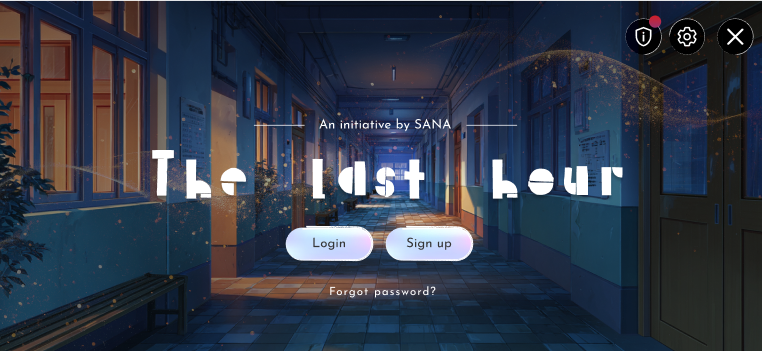
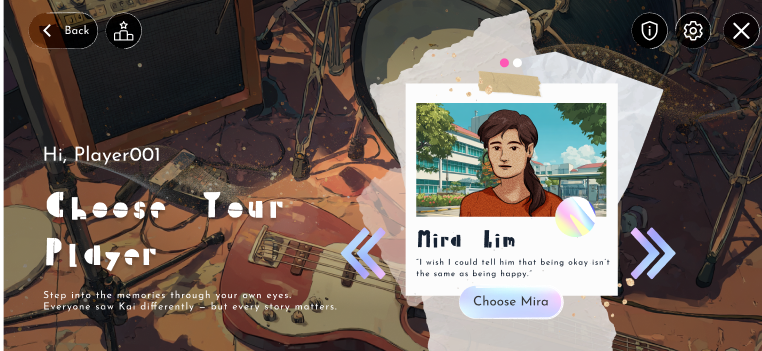
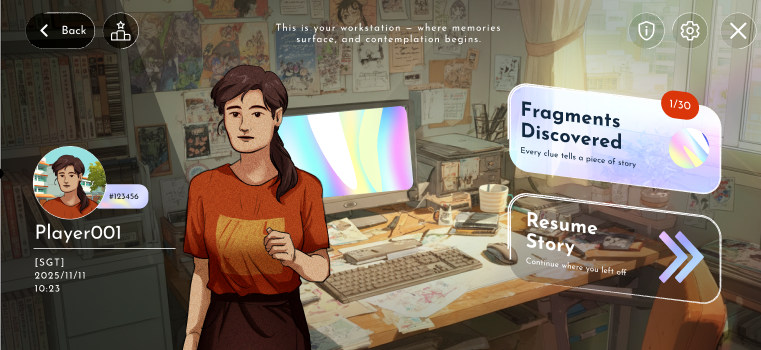
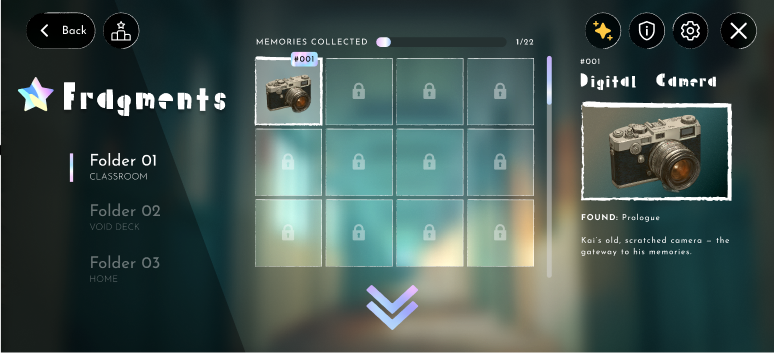
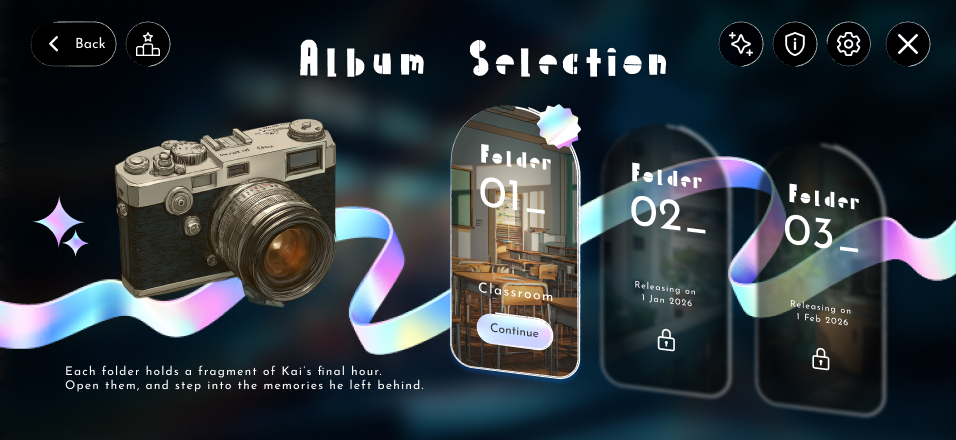
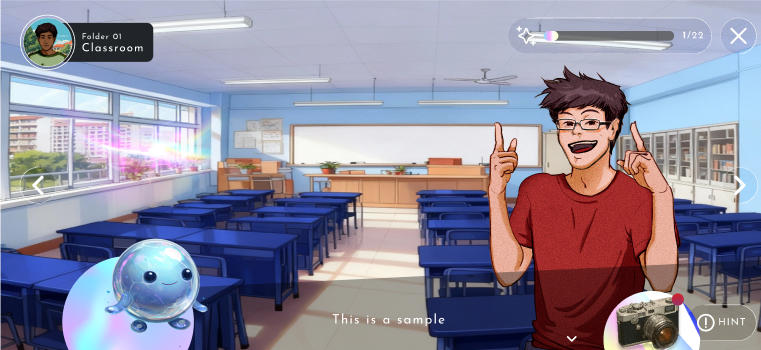
A few of my favourites. Every screen designed by hand, the last project where I went this deep into the craft myself.
Kai and the cast needed to feel specific to this world, so I brought an illustrator on for an original anime-style cast. That came with a constraint: he did not permit his character artwork to be modified or extended with generative AI. We respected it, AI could support environments, but the character art stayed untouched. In a static campaign that is easy; in an evolving interactive game, where new poses and expressions kept becoming useful, it was not.
For me the question was never whether AI should replace the illustrator. The job was a production workflow that respected the creator's terms while still letting the experience be built, which forced a clear boundary between original illustration and AI-assisted environments.
The most useful contradiction we found: we were asked for an escape experience, so discovery mattered, but in testing some clues were simply too hard to find. What felt discoverable to us was invisible to players. Too much guidance turns it into a tutorial; too little and players never reach the story. The lesson I kept: the environment still has to teach what can be touched, where attention goes, and when there is enough to move on. A puzzle succeeds not when the answer is clever, but when the player understands enough of its language to start.
The decision I still disagree with
My original reading of THE LAST HOUR was literal: the protagonist revisiting the final hour before something irreversible happens to their best friend, every clue and decision heavier because time is running out. Our original concept let that consequence become much darker. SANA eventually chose an ending centred on survival and rehabilitation instead.
I understood the reason. This was a prevention programme for young people, and it needed to communicate that support and recovery are possible. But narratively, I still think something was lost. Once the consequence changed, the title no longer carried the same weight for me. The strongest dramatic choice is not always the one that survives the programme objectives and stakeholder context. My responsibility was to challenge the decision where I believed it weakened the experience, then make the revised direction work once it was made. I still would have written the ending differently.
Outcome
Season One, THE LAST HOUR, launched on 1 July 2026, spanning three connected environments that combine exploration, narrative fragments, puzzles, collectibles, branching outcomes and original illustrated characters within one continuous story.
The hardest part was never a single screen or puzzle. It was that everything moved everything else: a changed learning requirement reshaped the story, which needed a new clue, which needed artwork that might not exist, which changed a puzzle, which changed the ending. My job was to hold it all coherent while the constraints kept shifting, part designer, part facilitator, part writer, part systems thinker, part Game Master.
Formal effectiveness evaluation sits with SANA, so I will not claim behavioural impact before those results exist. What I can claim is what it asked of me: after years spent mostly leading teams, research and strategy, this pulled me all the way back into the craft, from the story down to the screens.
What stayed with me
The hardest part of designing an escape room is not creating a clever puzzle. It is making dozens of clues, interactions and decisions feel like they were always part of the same story.